Agentic AI Workflows: Automate Multi-Step Business Processes
Learn how agentic AI workflows automate multi-step business processes across sales, support, finance, reporting, tools, rules, and human review.
Introduction
Most businesses are no longer asking whether AI can write a paragraph, summarize a meeting, or answer a question. They are asking a more useful question: can AI complete the messy, multi-step work that usually moves across people, tools, documents, approvals, and systems?
That is where agentic AI workflows are becoming important.
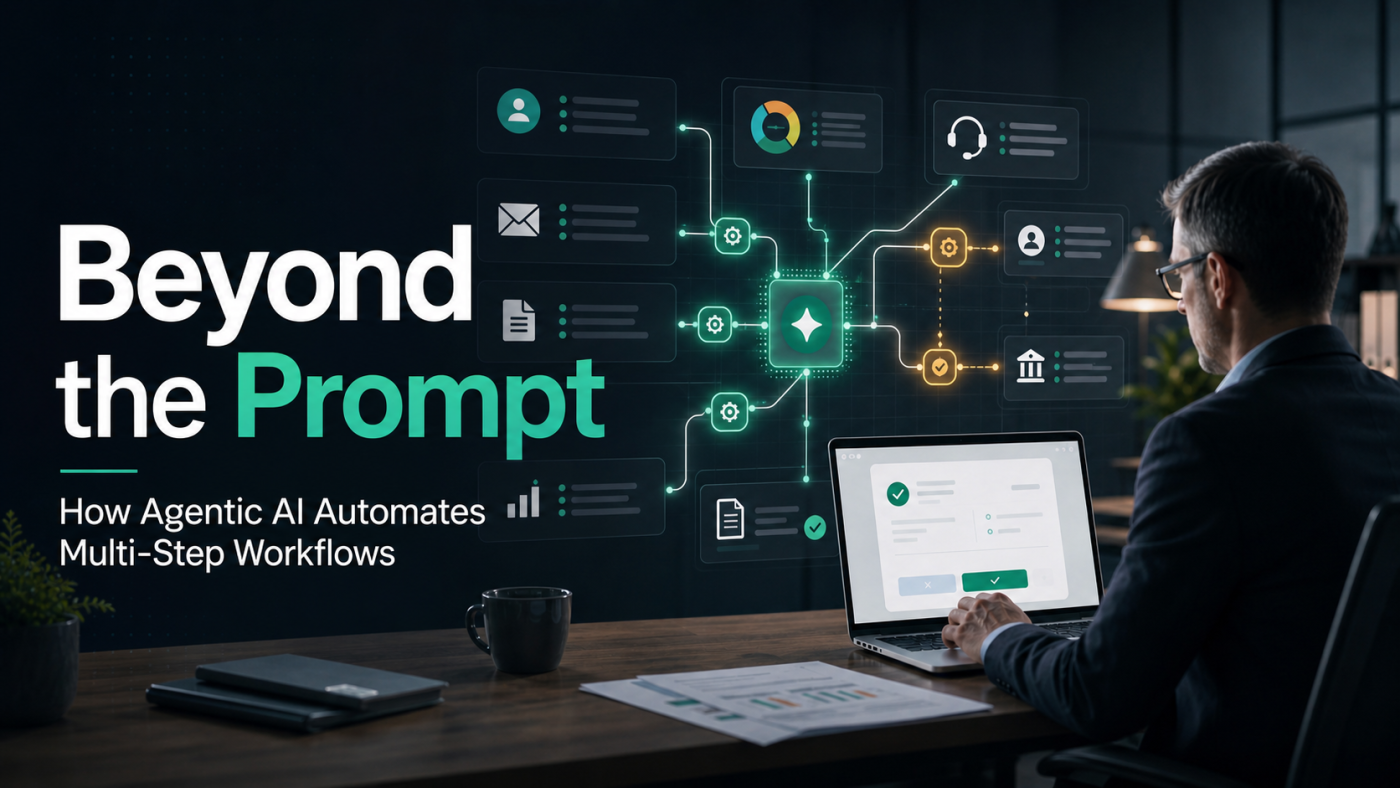
Instead of treating AI as a one-time prompt box, agentic AI uses models, tools, memory, business rules, and human review points to complete structured work from start to finish. For modern businesses, this means automating workflows such as lead qualification, customer support triage, invoice processing, market research, onboarding, reporting, and internal operations.
The shift is simple but significant: AI is moving from generating outputs to coordinating work.
What Agentic AI Means for Business Workflows
Agentic AI describes AI systems that can reason through a goal, break it into steps, use tools, make decisions within boundaries, and continue working until a defined outcome is reached.
A traditional AI prompt might look like this:
> Summarize this customer email.
An agentic workflow looks more like this:
- Read the customer email.
- Identify urgency, sentiment, product area, and account value.
- Check CRM history.
- Search past tickets and documentation.
- Draft a response.
- Route the ticket to the right team.
- Escalate if the customer is high-value or the issue is severe.
- Log the action and update the support system.
The difference is not just intelligence. It is orchestration.
Agentic AI connects language understanding with real business systems, making it useful for workflows that require context, judgment, and repeatable execution.
Why Businesses Are Moving Beyond One-Off Prompts
Prompt-based AI is helpful, but it depends heavily on the person using it. Someone has to know what to ask, paste the right context, interpret the output, move data between tools, and decide what happens next.
That creates three common problems:
- Work still depends on manual coordination.
- Results vary based on who writes the prompt.
- AI output often stops before the actual business process is complete.
Agentic AI workflows solve this by embedding AI inside the process itself. The business defines the goal, constraints, data sources, decision rules, and approval steps. The AI then operates within that structure.
This is especially useful when a workflow is frequent, high-volume, and rule-guided but still requires judgment.
Examples of Agentic AI Workflows in Modern Businesses
Sales Lead Qualification
An agentic AI system can monitor new inbound leads, enrich company data, analyze fit, score urgency, draft personalized outreach, and create CRM tasks for sales representatives.
A practical workflow might include:
- Capturing leads from forms, email, LinkedIn, or ads.
- Enriching records with company size, industry, funding, and technology stack.
- Comparing the lead against the ideal customer profile.
- Writing a tailored first-touch email.
- Assigning the lead to the correct sales owner.
- Creating follow-up reminders in the CRM.
The sales team still owns the relationship. The AI removes the repetitive research and routing work that slows the first response.
Customer Support Triage
Support teams deal with repetitive classification, routing, and context-gathering. Agentic AI can read incoming tickets, classify the issue, detect urgency, retrieve relevant documentation, draft responses, and escalate sensitive cases.
This helps teams reduce response time without fully removing human judgment.
For example, an AI support agent can:
- Identify billing, technical, onboarding, or account issues.
- Detect frustrated customers or churn risk.
- Pull account details from the CRM.
- Recommend a response based on internal knowledge.
- Escalate security, legal, or refund cases to a human.
The best implementations keep humans in the loop for high-risk or emotionally sensitive interactions.
Finance and Invoice Processing
Finance workflows are often structured but fragmented. Agentic AI can extract invoice data, validate it against purchase orders, flag anomalies, request missing information, and prepare approvals.
A strong workflow may include:
- Reading invoice PDFs from email.
- Extracting vendor, amount, tax, due date, and line items.
- Matching invoices against purchase orders.
- Checking approval thresholds.
- Flagging duplicates or unusual amounts.
- Sending approval requests.
- Syncing approved records into accounting software.
This reduces manual entry while preserving auditability.
Internal Reporting
Many teams spend hours gathering updates from different tools just to create weekly reports. Agentic AI can collect metrics, summarize changes, highlight risks, and generate a concise business update.
For example, a weekly operations agent could:
- Pull sales metrics from the CRM.
- Review support ticket trends.
- Summarize engineering delivery status.
- Check marketing campaign performance.
- Identify blockers and anomalies.
- Draft a leadership update.
The result is not just a generated report. It is a repeatable reporting system.
The Core Components of an Agentic AI System
A reliable agentic AI workflow usually includes several layers.
1. Goal Definition
The system needs a clear business objective. Weak goals produce weak automation.
Instead of saying "help with sales," define the workflow as:
> Qualify inbound demo requests, score each lead, enrich missing company data, and prepare a personalized outreach draft within five minutes.
Specific goals make the agent easier to test, monitor, and improve.
2. Tool Access
Agentic AI becomes useful when it can interact with real systems. Common integrations include:
- CRM platforms
- Help desk tools
- Email and calendar systems
- Databases
- Internal knowledge bases
- Document storage
- Analytics dashboards
- Project management tools
- Accounting software
Tool access should be permissioned carefully. The AI should only access the systems and actions required for the workflow.
3. Business Rules
AI should not make every decision freely. Strong workflows combine model reasoning with explicit rules.
Examples include:
- Escalate enterprise customers automatically.
- Never approve refunds above a set threshold.
- Require human review before sending legal, medical, or financial advice.
- Do not update production systems without validation.
- Log every external action.
Business rules turn AI from a clever assistant into a controlled operational layer.
4. Memory and Context
Agentic workflows often need context from previous interactions, customer history, documentation, or company policy.
Useful context may include:
- Customer profile and account history
- Past support tickets
- Internal SOPs
- Brand voice guidelines
- Product documentation
- Previous workflow outcomes
- Team-specific preferences
The key is to provide enough context for good decisions without overwhelming the system with irrelevant data.
5. Human Review
Modern businesses should not automate every step blindly. Human-in-the-loop design is essential for quality, safety, and trust.
Human review is especially important when workflows involve:
- Customer-facing messages
- Financial approvals
- Legal or compliance decisions
- Sensitive personal data
- High-value accounts
- Irreversible system changes
The goal is not to remove people from the process. It is to let people focus on the decisions that deserve human attention.
Benefits of Agentic AI Workflow Automation
Agentic AI workflows can create meaningful operational improvements when applied to the right processes.
Faster Cycle Times
AI agents can gather information, perform checks, and prepare next steps much faster than manual coordination. This is valuable in workflows where speed matters, such as sales response, incident triage, and customer support.
More Consistent Execution
Human teams often handle the same workflow differently depending on experience, workload, or available context. Agentic systems can enforce consistent steps, rules, and documentation.
Better Use of Skilled Teams
Many skilled employees lose time to repetitive coordination work. Agentic AI can handle the administrative layer so teams spend more time on judgment, strategy, customer conversations, and exception handling.
Improved Visibility
A well-designed AI workflow logs actions, decisions, confidence levels, approvals, and outcomes. This creates better visibility than informal manual processes spread across email, chat, and spreadsheets.
Risks and Tradeoffs to Manage
Agentic AI is powerful, but it needs careful implementation. The main risks are not only technical; they are operational.
Over-Automation
Not every workflow should be automated end to end. If the process is unclear, politically sensitive, or constantly changing, start with AI assistance before moving toward autonomous execution.
Poor Data Quality
AI workflows depend on the quality of connected systems. If CRM data is outdated, documentation is inconsistent, or policies are scattered, the workflow will inherit those problems.
Lack of Observability
Businesses need to know what the AI did, why it did it, and where it failed. Without logs, evaluation, and review dashboards, agentic automation becomes difficult to trust.
Security and Permissions
AI agents should follow least-privilege access. A customer support agent does not need access to payroll data. A reporting agent does not need permission to delete CRM records.
Unclear Ownership
Every workflow needs a business owner. Someone must define success metrics, approve changes, review failures, and decide when automation boundaries should change.
How to Start With Agentic AI in Your Business
The best starting point is not the flashiest workflow. It is a workflow that is frequent, painful, measurable, and bounded.
Good first candidates often have these traits:
- The process happens many times per week.
- The steps are mostly known.
- The data sources are accessible.
- Mistakes are recoverable.
- Human review can be added at clear points.
- Success can be measured with time saved, error reduction, or faster response.
A practical rollout might look like this:
- Map the existing workflow.
- Identify repetitive steps and decision points.
- Define what the AI can do, suggest, or never do.
- Connect the required tools and data sources.
- Start with draft or recommendation mode.
- Add logging and review.
- Measure performance against the manual process.
- Expand autonomy only where results are reliable.
This approach keeps the project grounded in business value instead of novelty.
What a Strong Agentic AI Architecture Looks Like
A production-ready agentic AI workflow usually includes more than a model call. It needs architecture around the model.
A typical setup may include:
- An orchestration layer to manage workflow steps.
- Tool connectors for business systems.
- Retrieval systems for company knowledge.
- Policy rules for permissions and approvals.
- Evaluation logic to test quality.
- Logging for traceability.
- Human review interfaces.
- Monitoring for errors and drift.
The model is important, but the surrounding system determines whether the workflow is reliable enough for real business use.
Conclusion: Agentic AI Workflows Are the Next Layer of Business Automation
Agentic AI workflows are changing how modern businesses think about automation. Instead of using AI only to generate text or answer isolated questions, companies can now automate multi-step workflows that involve context, tools, rules, and human review.
The opportunity is not to replace every process with an autonomous agent. The real value is building focused AI systems that remove repetitive coordination, improve consistency, and help teams move faster with better context.
Businesses that start with clear workflows, strong guardrails, and measurable outcomes will get the most from agentic AI automation.
Ready to turn this idea into a working system?
Share your goals, workflow, or product challenge. We will review the details and recommend the most practical next step.
In This Article
- Introduction
- What Agentic AI Means for Business Workflows
- Why Businesses Are Moving Beyond One-Off Prompts
- Examples of Agentic AI Workflows in Modern Businesses
- The Core Components of an Agentic AI System
- Benefits of Agentic AI Workflow Automation
- Risks and Tradeoffs to Manage
- How to Start With Agentic AI in Your Business
- What a Strong Agentic AI Architecture Looks Like
- Conclusion: Agentic AI Workflows Are the Next Layer of Business Automation
Discussion
Share your thoughts, questions, or practical experience below.
No comments yet. Be the first to share a thoughtful question or perspective.