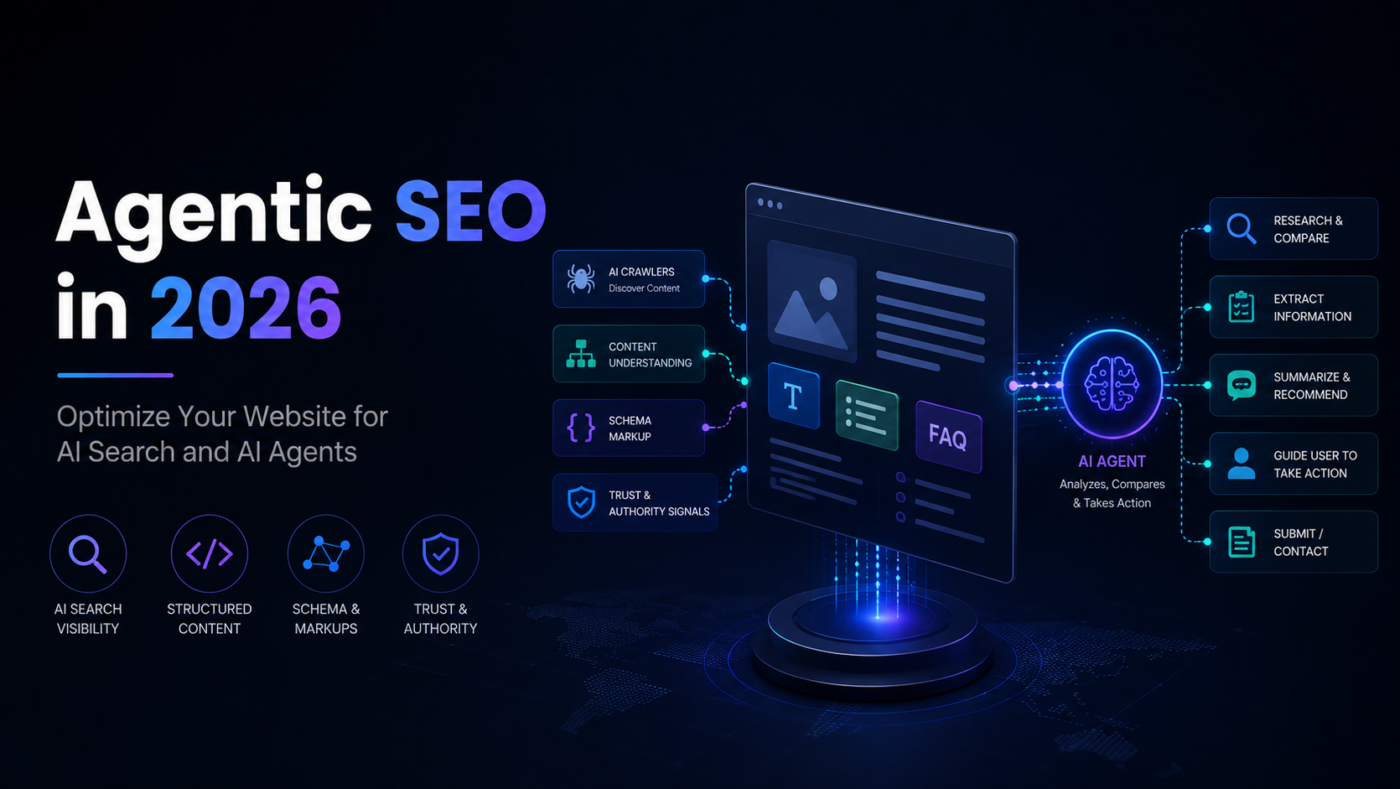
Agentic SEO in 2026: Optimize Your Website for AI Search and AI Agents
Learn how agentic SEO in 2026 helps websites become visible, understandable, and trustworthy for AI search engines and AI agents.
Introduction
Agentic SEO in 2026 is becoming an important topic for businesses that want to stay visible as search behavior changes. People are no longer discovering companies only through traditional search results. They are also using AI assistants, AI-powered search engines, answer engines, and autonomous agents that research, compare, summarize, and sometimes take action on behalf of users.
This creates a new challenge for business websites.
Traditional SEO helps search engines crawl, rank, and display your pages. Agentic SEO goes a step further. It helps AI systems understand what your business does, trust your information, compare your services, and recommend your website when a user asks for help.
For companies investing in web development, content marketing, technical SEO, SaaS platforms, or AI automation, agentic SEO is not just another trend. It is part of how websites need to be structured for modern discovery.
What Is Agentic SEO?
Agentic SEO is the process of optimizing a website so AI agents and AI search systems can understand, evaluate, and act on its content.
An AI agent is different from a normal search crawler or chatbot. Instead of only listing pages, an agent may complete a multi-step task such as:
- Researching service providers
- Comparing prices and features
- Reading reviews and case studies
- Checking documentation
- Filling out a contact form
- Creating a shortlist of vendors
- Recommending the best option to a user
That means your website needs to do more than rank for keywords. It must clearly explain your services, prove your credibility, expose useful structured information, and make important actions easy for both humans and machines.
In simple terms:
> Traditional SEO helps people find your website. Agentic SEO helps AI systems understand and recommend your website.
Why Agentic SEO Matters in 2026
Search is becoming more conversational, more automated, and more decision-oriented. A user may ask an AI assistant:
- "Find me a web development company for a SaaS MVP."
- "Compare agencies that build AI automation systems."
- "What is the best way to optimize my WordPress website for speed?"
- "Which company can build a custom chatbot for customer support?"
In these journeys, the AI system may read multiple websites, summarize options, compare claims, and present only a few recommendations. If your website is unclear, hard to crawl, thin on details, or missing trust signals, it may be ignored even if it looks good to a human visitor.
Agentic SEO matters because AI discovery rewards websites that are:
- Easy to crawl
- Clear about services and offers
- Rich in structured information
- Supported by credible examples
- Fast and technically clean
- Consistent across pages
- Helpful for specific user questions
Businesses that prepare early can build topical authority before the competition catches up.
Agentic SEO vs Traditional SEO
Traditional SEO is still important. Keywords, backlinks, page speed, mobile performance, metadata, internal links, schema, and useful content all continue to matter.
The difference is that agentic SEO focuses more strongly on machine understanding and task completion.
Traditional SEO Focuses On Ranking
Traditional SEO asks:
- Can search engines crawl the page?
- Does the page target the right keyword?
- Is the content useful for the search intent?
- Does the page load quickly?
- Does the site have authority?
- Can users find what they need?
These fundamentals are still required.
Agentic SEO Focuses On Understanding and Action
Agentic SEO adds new questions:
- Can an AI assistant understand exactly what this business offers?
- Can it compare this service with alternatives?
- Can it extract pricing, process, features, location, and contact details?
- Can it identify proof such as case studies, testimonials, and project examples?
- Can it complete useful actions such as submitting a form or guiding a user to the right page?
- Can it trust the website enough to cite or recommend it?
The goal is not to replace traditional SEO. The goal is to make your existing SEO strategy ready for AI search and AI agents.
How AI Agents Read and Evaluate Websites
AI agents evaluate websites differently from a normal visitor scanning a page. They look for clarity, structure, confidence, and enough context to answer a user's question accurately.
Clear Service Definitions
If your website says "we build digital solutions," that is too vague. AI systems need specific service language.
A stronger service description might say:
- Custom web application development
- WordPress performance optimization
- AI chatbot development
- SaaS MVP development
- Mobile app development
- CRM and API integrations
- AI automation workflow development
Specific language improves both human conversion and AI understanding.
Structured Pages
AI systems prefer pages that are organized around clear headings, concise sections, lists, FAQs, and consistent terminology. A visually impressive page with little crawlable text may perform poorly in AI search.
Useful structure includes:
- One clear topic per page
- Descriptive headings
- Short paragraphs
- Service-specific FAQs
- Comparison sections
- Process steps
- Use cases
- Technical details where relevant
Trust Signals
AI search systems often compare claims across multiple sources. Your website should include evidence that supports your expertise.
Trust signals may include:
- Case studies
- Client industries
- Technology stack
- Project screenshots
- Testimonials
- Team expertise
- Clear contact details
- Transparent process
- Useful educational content
For service businesses, proof is especially important because AI systems may need to decide whether your company is credible enough to recommend.
Technical SEO Foundations for AI Search
Agentic SEO depends on strong technical SEO. If your website is slow, blocked, hard to crawl, or dependent on JavaScript for important content, AI systems may struggle to understand it.
Crawlable Content
Important content should be available in the HTML response whenever possible. If core service descriptions, pricing, FAQs, or calls to action only appear after heavy client-side rendering, some AI crawlers may miss or misread them.
Make sure crawlers can access:
- Main page content
- Service descriptions
- Navigation links
- FAQ sections
- Contact details
- Blog articles
- Case studies
- Pricing or package information where appropriate
Schema Markup
Schema markup helps search engines and AI systems interpret content more accurately.
Useful schema types for business websites include:
OrganizationLocalBusinessServiceFAQPageArticleBreadcrumbListProductfor SaaS or software offersReviewwhere valid and compliant
Schema is not magic, but it reduces ambiguity. It gives machines a clearer map of your website.
Fast Page Performance
AI search does not remove the need for speed. Fast pages improve user experience, crawl efficiency, and conversion rates.
Focus on:
- Core Web Vitals
- Mobile performance
- Optimized images
- Clean frontend code
- Server-side caching
- CDN usage
- Reduced JavaScript bloat
- Stable layout and navigation
Performance is especially important for business websites that rely on landing pages, blogs, service pages, and lead generation forms.
Content Strategy for Agentic SEO in 2026
Agentic SEO content should answer real buyer questions clearly. Instead of publishing generic articles, build a topic cluster that proves expertise across your main services.
For a software development or AI automation company, useful topic clusters may include:
- AI automation for business workflows
- Custom web application development
- SaaS MVP development
- WordPress performance optimization
- AI chatbot development
- RAG and knowledge base systems
- CRM and API integrations
- Technical SEO and website performance
- Cloud database architecture
Each cluster should include practical articles that explain problems, solutions, tradeoffs, costs, implementation steps, and common mistakes.
AI systems are more likely to trust a website that covers a topic deeply across multiple related pages instead of publishing one thin article around a trending keyword.
Practical Agentic SEO Checklist
Use this checklist to make your website more AI-ready in 2026.
Website Structure
- Create dedicated pages for each major service.
- Use descriptive page titles and meta descriptions.
- Keep navigation simple and crawlable.
- Add breadcrumbs for deeper pages.
- Avoid hiding important content behind tabs that do not render clearly.
- Make contact, quote request, and booking paths easy to find.
Content Clarity
- Explain what each service includes.
- Add who the service is for.
- Describe the process step by step.
- Include deliverables and expected outcomes.
- Add FAQs based on buyer questions.
- Use natural language, not only marketing slogans.
- Include comparison sections where helpful.
Technical Signals
- Add relevant schema markup.
- Improve page speed and Core Web Vitals.
- Make sure important content is crawlable.
- Use clean URLs.
- Fix broken links and redirect chains.
- Submit updated sitemaps.
- Keep robots.txt clear and intentional.
Trust and Authority
- Publish case studies or project examples.
- Show industries served.
- Mention technologies used.
- Add testimonials when available.
- Keep author, company, and contact information clear.
- Update old content with current examples.
- Build internal links between related articles and services.
AI Search Readiness
- Answer direct questions early in the page.
- Add concise summaries before deeper explanations.
- Use FAQ sections for conversational queries.
- Make service, location, and contact information easy to extract.
- Consider
llms.txtif your content strategy supports it. - Monitor how your brand appears in AI search tools.
What Is LLMs.txt and Should You Use It?
llms.txt is an emerging idea for helping AI systems understand important website content. It is similar in spirit to giving AI models a clean guide to your most useful pages, documentation, policies, or resources.
For many businesses, llms.txt is not a replacement for strong SEO. It should not be treated as a shortcut. Your main website still needs crawlable content, good structure, schema, internal links, and useful pages.
However, llms.txt may be useful when your website has:
- Technical documentation
- API references
- Product guides
- Service guides
- Educational resources
- Complex content that benefits from a clear index
If you use it, keep it accurate, simple, and aligned with the pages you actually want AI systems to understand.
Common Agentic SEO Mistakes
Many businesses will approach AI search optimization the wrong way at first. Avoid these mistakes:
- Publishing vague AI-generated content: Thin content does not build trust.
- Ignoring technical SEO: AI systems still need crawlable, fast, structured websites.
- Hiding key information: Important service details should not be buried or unavailable to crawlers.
- Skipping schema markup: Structured data helps reduce confusion.
- Overusing buzzwords: Clear language beats trend-heavy language.
- Forgetting conversion paths: Visibility is useful only if users and agents can take the next step.
- Neglecting topical authority: One article is not enough to own a topic.
- Ignoring brand consistency: AI systems compare information across sources, so inconsistent claims can weaken trust.
Agentic SEO FAQ
Is agentic SEO replacing traditional SEO?
No. Agentic SEO builds on traditional SEO. You still need keywords, strong content, technical performance, links, metadata, schema, and a good user experience. Agentic SEO adds more focus on AI understanding, structured information, and task completion.
What is the best first step for agentic SEO?
Start by improving your core service pages. Make sure each page clearly explains the service, target audience, process, deliverables, FAQs, proof, and next step. Then add schema and improve page performance.
Do small businesses need agentic SEO in 2026?
Yes, especially if they depend on search visibility, local discovery, online leads, or service comparisons. Small businesses can start with clear pages, FAQs, structured data, and strong local or niche content.
Is LLMs.txt required for AI search visibility?
No. llms.txt is not required, and it should not replace technical SEO or high-quality content. It can be useful as an additional signal for websites with documentation, guides, or structured resources.
Can AI agents fill out website forms?
Some AI agents can interact with websites and complete tasks. This makes clean forms, clear labels, accessible design, and simple conversion paths more important.
How long does agentic SEO take to work?
Agentic SEO is a long-term strategy. Technical improvements can help quickly, but topical authority, AI visibility, and trust signals usually improve over time as your website becomes clearer, deeper, and more consistent.
How CodeHills Can Help With Agentic SEO
Agentic SEO is not only a content task. It combines web development, technical SEO, content architecture, structured data, automation, and conversion design.
At CodeHills, we help businesses build websites and digital platforms that are ready for modern search behavior. That can include:
- Technical SEO audits
- Website performance optimization
- Service page restructuring
- Schema markup implementation
- WordPress optimization
- AI-ready content planning
- Custom web application development
- AI chatbot and automation integration
- CRM, API, and backend workflow connections
The goal is to make your website easier for humans to use and easier for AI systems to understand.
Final Thoughts
Agentic SEO in 2026 is about preparing your website for a search environment where AI systems help users make decisions. Ranking on Google still matters, but visibility is expanding into AI assistants, answer engines, and autonomous agents.
Businesses that invest in clear content, strong technical SEO, structured data, fast performance, and trustworthy service pages will be better positioned for this shift.
The best time to prepare is before agentic search becomes crowded. Start with the pages that matter most, make your expertise easy to understand, and build a website that AI systems can confidently interpret and recommend.
Ready to turn this idea into a working system?
Share your goals, workflow, or product challenge. We will review the details and recommend the most practical next step.
In This Article
- Introduction
- What Is Agentic SEO?
- Why Agentic SEO Matters in 2026
- Agentic SEO vs Traditional SEO
- How AI Agents Read and Evaluate Websites
- Technical SEO Foundations for AI Search
- Content Strategy for Agentic SEO in 2026
- Practical Agentic SEO Checklist
- What Is LLMs.txt and Should You Use It?
- Common Agentic SEO Mistakes
- Agentic SEO FAQ
- How CodeHills Can Help With Agentic SEO
- Final Thoughts
Discussion
Share your thoughts, questions, or practical experience below.
No comments yet. Be the first to share a thoughtful question or perspective.